Digital sales teams are under constant pressure to lift conversion. Meanwhile, creating an effective compliance system remains on the backburner... until a major incident or ACCC fine suddenly makes the hidden weakness visible.
At the same time, executives are under pressure to “do AI”.
AI can seem like a silver bullet in this climate. Simply give the laws, policies, product rules and disclosure standards to a bot, then ask it to make the compliance problem disappear.
That way, digital can keep shipping while the machine watches for risk.
You wish.
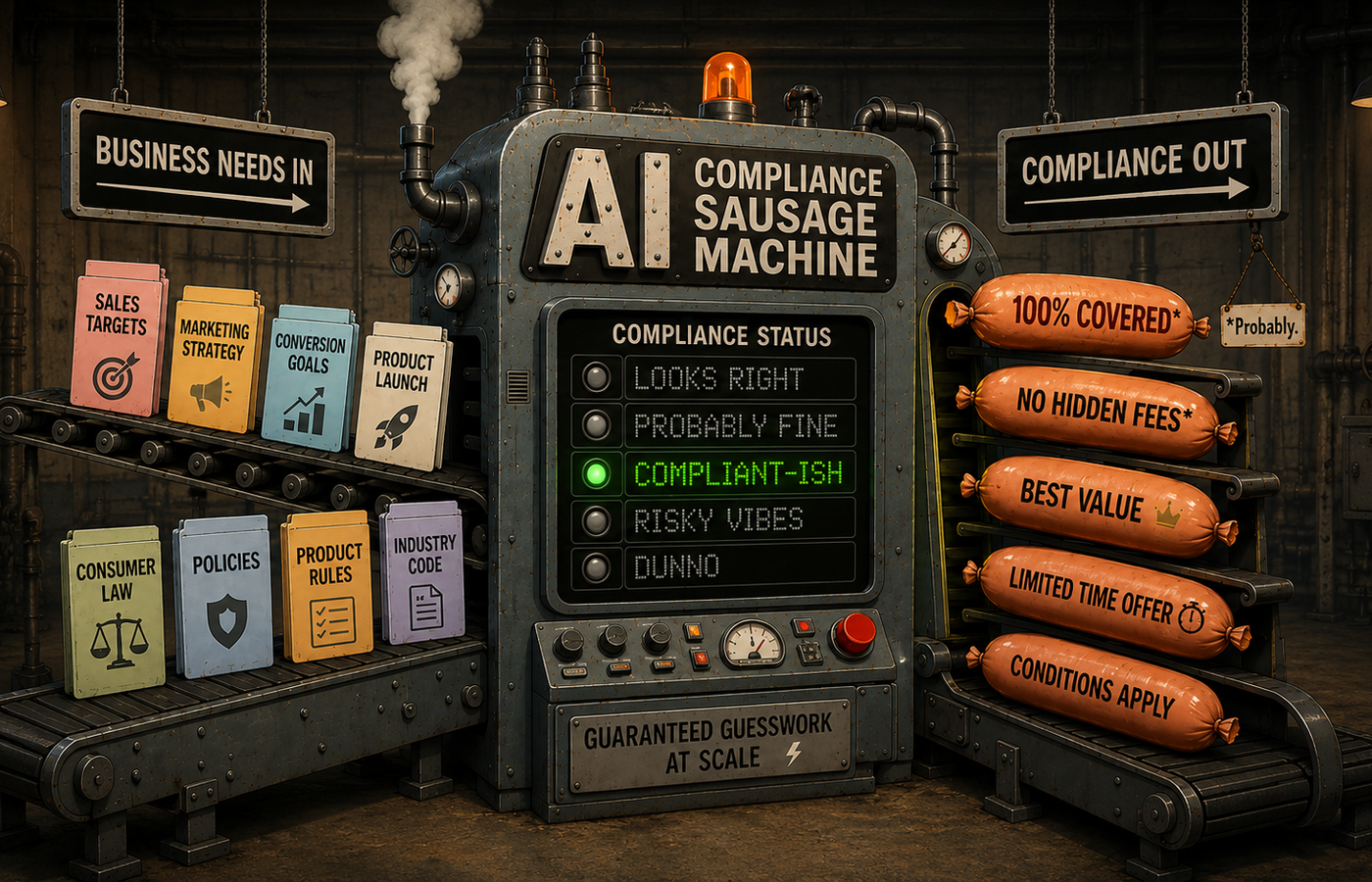
A poorly designed AI-powered system does not create compliance. It creates really fast guesswork.
The outcome will likely be more work, not more certainty
The obvious use for such a system is an automated auditor that scans digital pathways, compares the live experience against source documents, flags risk and conducts triage.
That's a powerful deployment, but it's also reactive. It tells the business where risk may already have been designed into the journey.
The more powerful use case is proactive: a compliance assistant that supports product, digital and content teams as they design and optimise the experience.
Such a system can surface relevant obligations, summarise legal advice in plain English, suggest proportionate disclosure treatments, help draft compliant content, and capture the rationale behind decisions.
By building the expertise into the system, the emphasis shifts from late-stage compliance remediation, to embedding compliance into everyday delivery.
This is how you multiply the impact of your legal and risk teams without increasing headcount. But if the system is poorly designed, it could just as easily create unwarranted confidence or inundate stakeholders with false flags.
AI systems have a reputation for producing plausible-sounding nonsense, otherwise known as 'hallucinations'. That's obviously not something you want happening when the AI has been asked to detect compliance risks worth millions of dollars.
AI models are far less prone to hallucination than they used to be, but the risk remains real.
If you give an AI a vague question, an unclear process and insufficient source data then pressure it to answer, it may try to fill the gaps. Those gaps are where hallucinations and errors creep in.
Garbage in, garbage out.
AI becomes genuinely useful only when it operates within a system that's grounded in a thorough understanding of the business: its products, customers, obligations, risk appetite, operating model and commercial goals. It an be a powerful ally when given a clear question, properly structured source material, a carefully designed workflow and experienced human reviewers.
In practice this means a robust enterprise system needs:
- documented sources of truth
- product claim standards
- digital disclosure patterns
- risk thresholds
- review points
- escalation paths
- audit logs
- rationale capture
The question isn't: “Can we use AI to make compliance faster?”
The real question is: “Do we have a compliance system that AI can safely accelerate?”
A carefully designed AI-powered compliance system can help produce actionable compliance findings at scale. But the benefits stretch beyond faster content approvals and lower compliance risk.
An AI-powered compliance assistant could help digital teams build customer-centred experiences that are optimised to comply, rather than littered with disclaimers bolted on at the end.
Yes, a properly configured AI system can detect when a product page says one thing and a PDF says another. It may even detect when an important qualification is buried in an accordion rather than given the prominence required under consumer law.
But here's the rub: detection is not resolution.
A bot can make judgements, but it can't be accountable.
Only a person can own a risk.
That's why AI can't fix your compliance problem.